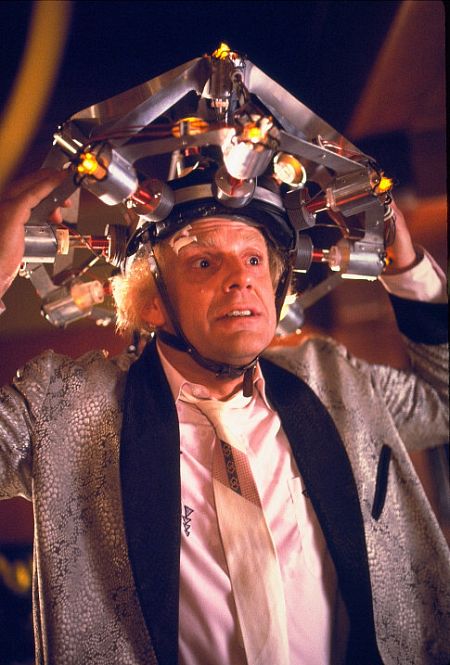
Showing posts with label Back to the Future. Show all posts

Sunday, October 03, 2010

Back to the Future turns 25

Not the first time this blog has pondered Back to the Future (notes on Doc Brown's inheritance here, and brief digression on the "we don't need roads" line with heated discussion in the comments here) - but last night was the first time I've ever seen the film in the cinema (it's currently on re-release to celebrate its 25th anniversary) - and a few fresh thoughts came to light.

- Marty's first line in the film - "Hey Doc? Doc? Hello? Anybody home?" - is a fun pre-echo of Biff's catchphrase ("Hello? Hello? Anybody home? Think, McFly, think.")

- Although the writers will doubtless be wrong about the everyday availability of hoverboards and miniature pizzas (you've got five years to abolish roads, Obama!), the fact that the time machine Mk.II runs on household waste does anticipate the rise of the recycling movement.

- PRO TIP: If you want to find out more about time and how it works, do a Google image search for Claudia Wells, who played Jennifer.

- On the big screen, you get a clearer sense of how many brands, signs and billboards there are jostling for attention (aside from, say, the Calvin Klein and Pepsi references within the script itself). The big JC Penney sign in the Twin Pines car park should feel like intrusive product placement, but it actually adds some colour to the scene - and its neon glow contrasts with Hill Valley's 1955 shops.

- I've always thought of BTTF as a perfectly plotted film, but in the cinema there are a few moments that are just too pat, and as a result, end up being unintentionally funny - for example, Doc pointing out that you can never predict when or where a bolt of lightning will strike is followed immediately by Marty's OH WAIT WHAT'S THIS FLYER I'M HOLDING? Despite clearly being fans, I sensed that my fellow cinema-goers also found it tricky to suspend their disbelief when Marty's family photo shows, um, his brother's head missing. ("Erased... from existence!")

- Doc's social ineptitude is wonderfully done - cf. his awkwardness when Lorraine turns up unannounced at the Brown residence, and as his hilarious description of the Enchantment Under the Sea ball as a "rhythmic ceremonial ritual".

- Just before departing for the future, Doc tells Marty: "I've always dreamed on seeing the future, looking beyond my years, seeing the progress of mankind. I'll also be able to see who wins the next twenty-five World Series." Is this a joke? He goes nuts when Marty tries to do something similar in the second film. (Brings us back to the question of where the Brown estate comes from.)

- Sarah and I are flying to India on our honeymoon exactly 25 years to the day after Marty and Doc's very first time travel experiment. October 26 is also the anniversary of the eradication of smallpox and the date the far side of the moon was first photographed.

- I enjoyed this analysis by Adam Smith (!) over on the Empire site (although he spelt 'Zemeckis' wrong):

Applying anything approaching rigorous criticism to Back To The Future would be like taking a jack-hammer to a perfectly risen souffle, but there are a number of intriguing readings to [Robert] Zemekis' movie, particularly since hostile critics of the directors' subsequent work, Forrest Gump and Contact, have detected in him a Capra-esque conservatism. You could make the case that BTTF is a manipulative critique of the 80s through the prism of an airbrushed version of the 50s that owes more to George Lucas' American Graffiti than the turmoil of the decade itself (the burning crosses and blacks dangling from trees are presumably "just out of shot").


Zemekis seems to be accusing the 80s of betraying the American Post War dream; Marty's frumpy, nervous, bullied family are not the way things were meant to turn out (next to them at the dinner table you wonder if Marty ever inquired whether he was adopted) in the same way that the grasping 80s are not the legitimate offspring of the "innocent" 50s. Of course this is all a bit speculative.

*takes jack-hammer to perfectly-risen souffle*

(Actually, as they watch George being bullied at school, Doc does murmur to Marty: "Maybe you were adopted.") Of course, when Marty returns to 1985 having put right what once went wrong, his family are a less "loser"-like version of themselves and seem to be living the '80s American dream. Which, on reflection, is why they seem a little bit like a bunch of badly-dressed yuppie assholes. Meanwhile, getting back home to the people he loves apparently isn't enough: Marty has to be rewarded with a big gas guzzler too.

- I wonder if this film has ever been shown in Libya.

Tuesday, January 23, 2007

A curious thing

On Sunday night I dreamt I was at a Huey Lewis and the News concert. They played The Power of Love FIVE TIMES.

Sunday, October 22, 2006

Bolt Action 5 / Dan Sartain / Back to the Future 3

On Saturday I went to see the band Angry Tom manages, Bolt Action 5. There are, of course, only four of them. They are all ridiculously young, look amazing, and have a healthy love of drum machines. A good sign: when they finished, there were girls queuing up to speak to them. That's not a metaphor: they were literally queuing. Their first single's going to be released on Tom's new label, the excellently-named No Pain in Pop (tagline: "I'm not going to lie to you, we're kind of a big deal"). Have a listen here.

This afternoon housemate Jamie, who I have unfairly maligned in this very weblog for the outrageous work perks he gets, got us guestlisted for Dan 'bring your gun and I'll bring my knife' Sartain at the Barfly. I can't be bothered writing an overlong encomium describing how ace it was, so I'll just say 'that man totally rocks'.

Dan Sartain
He has something of the Steve Buscemi about him,
don't you think? Check out the bassist, what a beard.


Excited drinking boys standing behind us: "This is amazing. It's only 3.30 in the afternoon and we're well on the way."

Dan SartainDan loves his snakes. Turn round and face me Sartain!

On the way home I bought some t-shirts from Camden market. I couldn't resist them, I'm sorry.

T-shirts

As we neared home, I suggested to Jamie we watch Back to the Future. We'd both seen the first film the other week, but as we were both exhausted and needed something light, we went for number three in the series as I thought the second film would probably be too complicated.

I've said before that re-watching the Back to the Future films is great, as there's always something new to spot. This time was no exception. When Doc's about to send Marty back to the 1885 Wild West, he says, "And remember, where you're going, there are no roads." A clever echo of the final line of the first film ("Roads? Where we're going, we don't need roads"). Fantastic.

Thursday, June 22, 2006

A short essay on Back to the Future

Doc Emmet Brown: mad scientist, or scientific madman?

Every time I watch the Back to the Future trilogy (believe me, this is quite often), something new emerges. There’s a lovely moment when Doc Brown sees that his dog, Einstein, is getting agitated. He goes over to the dog and reassures him: "Everything'll be all right, Einie." Which is weird when you think how throughout the films, the whole construction of reality – particularly the future – is constantly in doubt. Will everything really be all right? He says it with such conviction.

It was this train of thought that got me thinking about Doc Brown, and I came to some unexpected conclusions. Eagle-eared viewers will notice a number of references to "the Brown estate", money which Brown has inherited and used to fund his science experiments. But despite the films’ constant references to genealogy, particularly to the family McFly and the Tannen clan, there is never any mention of Brown's family.

At this stage, one begins to wonder whether in fact Brown's inheritance has in fact been "handed down" from himself to himself. But when his young friend Marty McFly attempts to profit from time travel (by taking a sports almanac from the future back to the present) Brown lambasts him. How is this different from what Doc seems to have done himself? One imagines Brown would defend himself by saying that he did it in the interests of science – and he would undoubtedly say the same when asked why he lied to and stole from a group of trusting Libyans. But how far will you let such moral relativism take you, Emmet?

When, in Back to the Future 2's 1955, Brown opens a suitcase full of money of a range of currencies, muttering "Need to be prepared for all eventualities," Marty looks up at him in surprise. In his mind a distant voice is challenging him, whispering, "Marty, how much do you really know about this 'Doc' man?" I have now heard that voice, but unlike poor Marty, I have heeded its words.

Monday, January 23, 2006

Don't write, speak or blink

Yesterday evening I was in the middle of watching Back to the Future Part III - I'd just got to the bit where Doc asks Clara Clayton to dance - when I got a call from Tim, a friend who I met whilst attempting to find myself in India back in 2003. When you hear the phrase "let's have a pint in Stockwell" you probably wouldn't immediately picture a darkly-lit incense-filled room filled with piles of exotic looking cushions, pints of San Miguel, a hookah of mango-flavoured tobacco and a game of chess. But somehow that was what happened.

After the game - Tim won, quite easily I suspect - he told me how he'd been working in SOAS library a few days ago when the wave of existential confusion that he's been experiencing for most of January finally overcame him. He began to rapidly scribble a short story about five friends, one called Fruity, onto the page in front of him. After several minutes of intense writing, the ink in his pen ran out. But he carried on writing the story regardless, despite the terrified looks coming from the guy sitting at the adjacent desk. I wondered whether perhaps this was the kind of thing that might precipitate an existential crisis, rather than prevent one, but apparently writing something which no one will ever be able to read, which will never even exist, was "very cathartic". A silent story, he called it.

This reminded me of a tale I'd heard sometime last year. A friend of a friend used to be a very talkative as a child. Her older brother found her constant chattering incredibly annoying and tried to think of ways he could get her to shut up. So he told her that all people have a limited number of words they're allowed to say and if they use up their allowance of words, they'll die. His trick worked, the flow of words was stemmed, and she became a reticent and silent child.

Tim responded by telling me about the lie his brother told him when he was younger. It was that repeated blinking would build up your facial muscles and give you very strong and defined cheeks. But Tim didn't want to have big toned cheeks that stuck out, so from that moment on, he tried to avoid blinking.

It was only this morning that I realised: our boardgame may have finished, but we were still playing what can only be described as Anecdote Chess. I also began to wonder whether perhaps the bar staff hadn't put a special something in the hookah.