
So my mate's mate - let's call him Joseph K. - goes for an interview at a big law firm. He's sitting in the waiting area with the other candidates and they're all handed out this simple personal details form to fill in. The last question is a "do you have a criminal record?" tick box, with space to write the details of the offence if you tick 'yes'.
All the other candidates finish the form, except Joseph, because he's had to tick the box and is busy writing in details. The atmosphere in the room has gone a bit tense; the other candidates - who've all finished - are all looking at him curiously as he scribbles away. No matter: soon he's relieved of the stares, as he's invited into the interview room, where a panel of five interviewers sit. He gives them the form.
The panel are pretty surprised, as he's the only candidate they've had who's ticked the box - and it's not every day you get someone with a criminal record applying for a law traineeship. They ask him why he has a conviction. He takes a deep breath.
"When I was a student, me and two mates have this great idea. We decide to dress up in sombreros and capes and head down to Wimbledon during the tennis competition to sell strawberries and cream to the fans. We get there, and for two hours it's going great: we're standing with the crowds, selling loads of strawberries, and it's a hot sunny day.
"But then this guy who we've just tried to sell a tray of strawberries to tells us he's an undercover police officer. At first we think this is just a wind up, but then he shows us his badge, pulls out his notebook and starts asking whether we have a license (we don't), how long we've been doing this for, and what our names and addresses are.
"The policeman says that he's going to have to report us. I'm like, 'Listen mate, we're just students having a laugh, trying to pay off our debts. Come on, have a strawberry.' The guy has no sympathy; he says no, and carries on writing, telling us that we'll each receive a court summons in two weeks' time. We're are still thinking that this is just a big joke and someone's having a bit of fun with us. Nevertheless all head home, feeling slightly dejected.
"Anyway, two weeks later, I find out that it definitely wasn't a joke - a court summons arrives in the post. The big day arrives and I turn up to court wearing my suit. I meet my mates there, and, unbelievably, they're dressed in the same sombreros and capes we were wearing down in Wimbledon. But - here's where it gets really crazy - I find out that not only am I being prosecuted for unlicensed selling, but I'm also being charged for attempting to bribe a police officer. With a strawberry.
"I get a twelve-month suspended sentence."
So Joseph finishes telling the story and the panel of interviewers are rolling around laughing their asses off. Any kind of stern manner they might have been trying on the other candidates has been completely diffused by this, the greatest of anecdotes. All the questions that follow are kind and sympathetic and he having already completely won them over, he can do no wrong. He gets the job.
Friday, April 28, 2006

Wednesday, April 26, 2006
Alan Bennett: wise, excellent, funny
Been reading Alan Bennett's enormous prose collection Untold Stories. He writes beautifully and (time to resort to cliché) is the master of the "wry observation". I'm only 200 pages in, but here are three favourites so far:
"It's a sign of my age that shoe shops seem nowadays to be staffed by sluts, indifferent, unhelpful and with none of that matronly dignity with which the selling of shoes and the buying of clothes were in those days conducted. It is a small loss..."
from 'Untold Stories'
30 January 1997: Meats is a form I don’t care for, the proper plural of meat being meat. Perhaps meats (on a van: 'British Premium Meats') means cooked meats, though meat would still be acceptable there, too. Meats suggests to me something not only cooked but sliced, and already beginning to curl at the edges. Odd that one should have any feelings, let alone care, about such usages.
Diaries 1996-2004
8 May 1997, New York: The names Americans visit on their children never cease to amaze me. One of Diana Ross’s daughters labours under the name of Chudney.
Diaries 1996-2004
"It's a sign of my age that shoe shops seem nowadays to be staffed by sluts, indifferent, unhelpful and with none of that matronly dignity with which the selling of shoes and the buying of clothes were in those days conducted. It is a small loss..."
from 'Untold Stories'
30 January 1997: Meats is a form I don’t care for, the proper plural of meat being meat. Perhaps meats (on a van: 'British Premium Meats') means cooked meats, though meat would still be acceptable there, too. Meats suggests to me something not only cooked but sliced, and already beginning to curl at the edges. Odd that one should have any feelings, let alone care, about such usages.
Diaries 1996-2004
8 May 1997, New York: The names Americans visit on their children never cease to amaze me. One of Diana Ross’s daughters labours under the name of Chudney.
Diaries 1996-2004
Tuesday, April 25, 2006
Oil never olive this down
I'm such a ponce. Plagued by the squeakiest bedroom door in Christendom, I finally solved the problem on Friday by rubbing the offending hinges with tissues doused in Sainsbury's olive oil. No doubt I'll soon be using a chorizo and rocket ciabatta as a door wedge.
Friday, April 21, 2006
Let Roberts sing
Julia Roberts made her stage debut on Broadway in the play Three Days of Rain this week. According to the Reuters report, good reviews have been "in the minority". New York Times critic Ben Brantley, a self-confessed 'Juliaholic' said he was struck with nervousness on entering the theatre "as if a relative or a close friend were about to do something foolish in public". There's a cracking line in his review:
"Your heart goes out to her when she makes her entrance in the first act and freezes with the unyielding stiffness of an industrial lamppost, as if to move too much might invite falling."
Thursday, April 20, 2006

Wednesday, April 19, 2006
An A to Z of 24
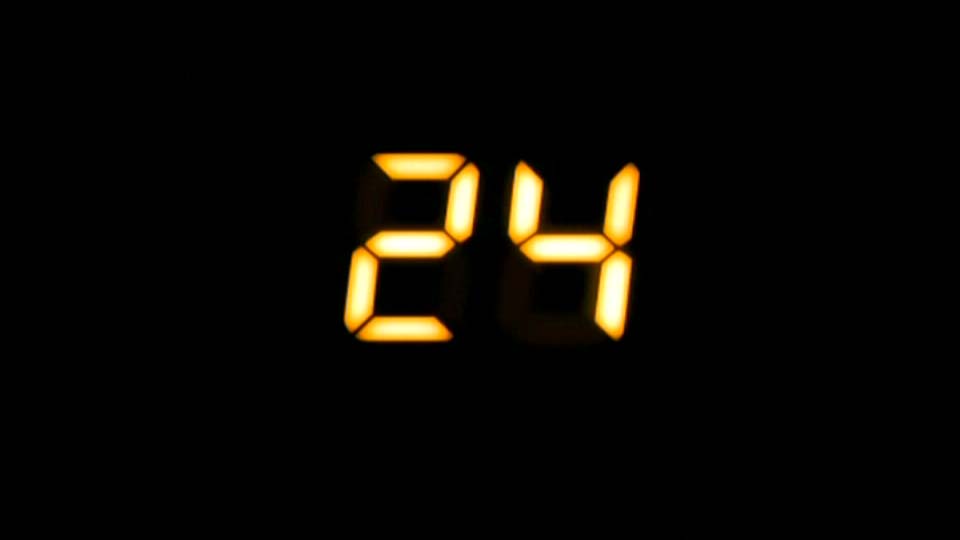 One of my current obsessions, is, of course, the TV show 24. I had a few things about the show that I needed to get off my chest, so I created this handy A to Z guide, designed for beginners and aficionados alike.
A is for Anonymity
Fairly sensibly, 24 doesn’t like to actually name which countries are supposedly flooding America's shores with terrorists. However, when this comes to the script, it’s unintentionally hilarious. Witness the President addressing his cabinet with the ridiculously vague command: "We must retaliate against these three Middle Eastern countries."
B is for Bomb
Often pronounced "balm", the premise of the programmes is often to locate the bomb (for different series, just substitute bomb for the appropriate object that needs to be located - virus, override, etc). While the uninitiated viewer might think 24 hours of Kiefer Sutherland shouting, "TELL ME WHERE THE BALM IS!" would be of little interest, it is in fact gloriously entertaining.
C is for Confess
What you should do if you’re sitting in the Counter Terrorism Unit's (CTU) interrogation room and someone says, "Get Richards in." See also Torture.
D is for Division
Little is known about what Division actually do. One theory is that Division has been invented solely to give Tony Almeida something to say during the quiet moments. That something is usually: "GET ME DIVISION!"
 E is for Edgar
24’s first fat character has been a huge success. He combines the grouchiness of Chloe with the computer wizardry of, er, Chloe, and throws in a charming lisp. What a legend.
F is for Food
Jack Bauer never eats anything. Why is there no trolley service at CTU?
G is for George Mason
Amusingly referred to as "Grumpybones Mason" by TV critic Charlie Brooker, and rightly so. Mason's excellent reaction upon finding out that he has radiation poisoning and will die within the next 12 hours is to look slightly irritated.
H is for Humour
It is illegal to crack a joke or raise a smile inside the CTU building, and so humour is very rare in 24. When it comes though, it's great:
Henry Powell: [being held at gunpoint by Jack and Tony] Who are you guys? Police? FBI?
Tony Almeida: Actually, I'm currently unemployed.
I is for Idiots
As Tony Almeida has pointed out, the people at Division (see D) are idiots. They occasionally pay CTU a visit to check up on their colleagues, but just end up looking even more like idiots.
J is for Jack
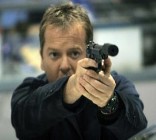
Obviously. There is something inherently satisfying about the name "Jack Bauer". Perhaps it is the successful "JB" combination of letters (James Bond, Jed Bartlett etc) – and some would say the popularity of the show itself depends upon this name. Which begs the question: how many shows are languishing in obscurity because of a poorly named hero?
K is for Kim
Jack’s daughter, constantly getting into all kinds of dangerous scrapes. For the viewer to complain about the fact that she has been kidnapped and attacked more times than is strictly probable is to miss the point. That’s what Kim does.
L is for Lear complex
The relationship between Jack and his daughter Kim has always been at the emotional core of the series, but they aren't the only lovey-dovey father-daughter pairing to feature. In fact, there are so many others, you do start to get a bit concerned about what's going on in the writers' heads.
M is for Millions
As in, "Tell us where the bomb is, or millions of innocent people will die!" Previously hardened terrorists obviously cave in under this sort of threat – and it’s the word 'millions' that does it.
N is for "NOW"
Used by Jack Bauer to great effect. When yelled correctly, this one word can triple the power of any command. For example:
"Put down your weapon and place your hands above your head." [Terrorist hesitates]
"NOW!" [Terrorist obeys]
O is for "Okaythankyou"
One of Jack’s many tics. Despite being a hugely aggressive action man, what gives Jack true hero status (apart from his name, see J), is his politeness. This is often manifested in the phrase "Okaythankyou", which Bauer endearingly delivers in the style of Dustin Hoffman's Rainman character, Charlie Babbitt.
 P is for Palmer
That’s President Palmer to you. At the end of series two, one terrorist managed to render him unconscious using a lethal reimagining of the old buzzer in the hand trick. The deadly poison (or whatever it was) was absorbed through the palm of the President's hand, giving his surname an added poignancy.
Q is for Quarter to
Roughly the time each episode when the tension gets hiked up.
R is for Ringtone
Or "uh-uh eeh-err". Never has a television show had more distinctive office ringtones. Well done to the sound effects department.
S is for Short-staffed
The HR department at CTU should be ashamed of themselves. Whenever there’s a bomb (see B) threatening to kill millions of innocent people (see M), there are never enough computer experts or top field agents to go round. So it’s normally left to Jack (in the field) and a hardy bunch of geeks to get the job done. And one of those is normally a mole.
T is for Time / Torture
Of course, 24 is all about time. ("I'm running out of time!" screams Jack on an hourly basis.) But the lack of time is often used as a justification for horrible torture, with many agents claiming they don’t have time to interrogate a suspect properly before reaching for the pliers and crocodile clips. Why? "Because millions of innocent people will die!" (see M)
NB It is part of 24 rules that most characters (even the good ones) will undergo some kind of torture. Think of it as an initiation thing.
U is for Unbelievable
How did Kim go from being an au pair to a top CTU computer expert in a year an a half? Well, if you had Jack Bauer’s genes, you’d expect no less. How can Tony Almeida be given his job back despite being fired, spending time in prison and becoming an alcoholic? Jack Bauer puts in a request, that’s how. How does Jack manage to conduct a high speed chase 'n' shoot on foot when his heart had stopped only hours before? He's Jack Bauer, that's how. In such a way, all suspect plot points can easily be explained away.
V is for Villains
All the characters in 24 have excellent names, but those of the villains are particularly great. Ramon Salazar, Victor Drazen and Ira Gaines, take a bow.
W is for Women, black

Three out of the four black women with major roles in 24 are deeply manipulative and unpleasant. To cap it all, three of them die from a bullet in the chest. What's going on there?
X is for Ex-Girlfriends
Jack doesn’t have much luck with the ladies. His wife Terri got kidnapped. Then she was killed by his ex-girlfriend Nina, who turned out to be an international terrorist. Next up was Kate, but this didn’t last – presumably Jack was bored with her two facial expressions. Claudia, Jack’s South American girlfriend, was shot and killed. Audiences were introduced to his current squeeze Audrey when she was kidnapped. On the plus side, she is still alive, though she must be wondering how much longer she’s got.
Y is for Yusuf
An Arab who actually wants to stop the terrorists? What's going on?
Z is for Zzzz
If you take one message away from the many hours spent watching 24, it should be this: sleep deprivation is good for you. Never sleep.
More Electric Goose 24-related garbage:
Apocalypse Bau(er)
Jack Joke
Absolute Bauer corrupts absolutely
Tuesday, April 18, 2006
Paul Simon: a bad influence
I should be in bed. I should be able to go into work this morning fresh and refreshed from my Easter break. Instead, I’m in a Farringdon pub with two drunken Canadians, Paul and Simon. I like the way those names complement each other (Paul Simon), but I only came here for a few brief pints.
Paul and Simon have been drinking since three. They meant to come to the pub for one pint before heading onto an art exhibition which featured exploding road signs or something. But the lure of alcohol has proved too tempting.
I arrive at 7pm. What have they been doing for the last four hours?
"We were talking to these girls. But they were all 17."
"And they left three hours ago."
Over the course of the evening, I hear some extraordinary anecdotes: Moscow-dwelling Paul describes how every month, he gets taken into a small room and paid in carrier bags of cash; paparazzo Simon excitedly tells me how he was recently sent out to snap a grieving family and "got a point blank close-up of the mother weeping."
Soon conversation descends into talk of Russian prostitutes; this continues for around an hour.
And suddenly we’re sitting outside the pub. Simon is shouting – in a terrible English accent – "Millwaaaaallll" and swinging a chair around his head. Paul is demonstrating his unnervingly convincing Anglo-voice, embarking on a circular monologue which begins something like, "I disembarked the tube at Beckenham Junction, as I was supposed to meet my Press Club pals in the centre of town..." and goes on and on in similar fashion. Meanwhile, Simon keeps interrupting, with his Millwall chant and chair swinging.
Shortly after, we're at the train station. Me and Paul have left Simon in the Costcutter – he needs crisps. As we walk down the stairs towards the platform, he reappears, excitedly clutching a bag of cheese Doritos. He suddenly whips a copy of the National Enquirer out of his inside pocket like he’s a master magician. On the train, I ask him why he loves the Enquirer (sample headline: 'CRACK TURNED WHITNEY INTO A SEX-CRAZED MONSTER' Says Sister-In-Law) so much. "Because it’s got all the top stories – before they happen," he slurs.
I leave the two crazies, and as I stagger off the train at Elephant and Castle, I wonder how my Easter break ended like this.
Paul and Simon have been drinking since three. They meant to come to the pub for one pint before heading onto an art exhibition which featured exploding road signs or something. But the lure of alcohol has proved too tempting.
I arrive at 7pm. What have they been doing for the last four hours?
"We were talking to these girls. But they were all 17."
"And they left three hours ago."
Over the course of the evening, I hear some extraordinary anecdotes: Moscow-dwelling Paul describes how every month, he gets taken into a small room and paid in carrier bags of cash; paparazzo Simon excitedly tells me how he was recently sent out to snap a grieving family and "got a point blank close-up of the mother weeping."
Soon conversation descends into talk of Russian prostitutes; this continues for around an hour.
And suddenly we’re sitting outside the pub. Simon is shouting – in a terrible English accent – "Millwaaaaallll" and swinging a chair around his head. Paul is demonstrating his unnervingly convincing Anglo-voice, embarking on a circular monologue which begins something like, "I disembarked the tube at Beckenham Junction, as I was supposed to meet my Press Club pals in the centre of town..." and goes on and on in similar fashion. Meanwhile, Simon keeps interrupting, with his Millwall chant and chair swinging.
Shortly after, we're at the train station. Me and Paul have left Simon in the Costcutter – he needs crisps. As we walk down the stairs towards the platform, he reappears, excitedly clutching a bag of cheese Doritos. He suddenly whips a copy of the National Enquirer out of his inside pocket like he’s a master magician. On the train, I ask him why he loves the Enquirer (sample headline: 'CRACK TURNED WHITNEY INTO A SEX-CRAZED MONSTER' Says Sister-In-Law) so much. "Because it’s got all the top stories – before they happen," he slurs.
I leave the two crazies, and as I stagger off the train at Elephant and Castle, I wonder how my Easter break ended like this.
Sunday, April 16, 2006
Spark plug
This morning, prompted by the recent news of the death of author Muriel Spark, my Mum began reminiscing about her old sixth-form English class in which she studied Spark's work under an inspirational teacher known as "Buckle". Buckle was so named because of her buck teeth. "She had a face like a pig," Mum said, though not unkindly.
Spark's most famous novel was the brilliant The Prime of Miss Jean Brodie, which tells the story of an unorthodox teacher who leaves a lifelong impression on her class of girls but also spends lessons extolling the virtues of Mussolini and is eventually sacked following an affair with the art teacher. Given such a storyline, it seems notably strange that Buckle, echoing Brodie, referred to my Mum's class as "the crème de la crème", and continued to do so years after they'd left. Despite such sinister undertones, they all got 'A's and this was where my mother's love of literature and reading really began. In the words of Jean Brodie, "Give me a girl at an impressionable age, and she is mine for life."
Spark's most famous novel was the brilliant The Prime of Miss Jean Brodie, which tells the story of an unorthodox teacher who leaves a lifelong impression on her class of girls but also spends lessons extolling the virtues of Mussolini and is eventually sacked following an affair with the art teacher. Given such a storyline, it seems notably strange that Buckle, echoing Brodie, referred to my Mum's class as "the crème de la crème", and continued to do so years after they'd left. Despite such sinister undertones, they all got 'A's and this was where my mother's love of literature and reading really began. In the words of Jean Brodie, "Give me a girl at an impressionable age, and she is mine for life."
Saturday, April 15, 2006
ZoomClouds
More nifty internet magic here. I made myself my very own word cloud. That's to say, the good people at ZoomClouds generated me one. What the bejesus am I talking about? Well, ZoomCloud is able to autogenerate a box of tags by searching the most used words from an RSS feed (or feeds) supplied by the user (in this case, the Electric Goose's Atom feed) - and you don't need to have tagged blog entries to do it. You get to design the box, mincing around with colours and padding like you're a cross between The Terminator and Laurence Llewellyn-Bowen. ZoomClouds then generates you a phat pile of CSS, which you thrust into the heart of your preexisting HTML, Mortal Kombat "finish him!" style.
If the wordy jargon in that so-called explanatory paragraph didn't stop you, the bad similes probably did. Ack well, just check it out for yourself: I've stuck the thing in the right hand side. You lucky people.
If the wordy jargon in that so-called explanatory paragraph didn't stop you, the bad similes probably did. Ack well, just check it out for yourself: I've stuck the thing in the right hand side. You lucky people.
Friday, April 14, 2006
Subscribe to:
Posts (Atom)


 Posts
Posts


